The Divine and Supernatural Faculties

*This post was written after the project was complete

Edwards bookHow do we experience God? How is he made known to us?

Jonathan Edwards wrestles through these questions in A Divine and Supernatural Light. Edwards believes that man has experiences the light though his own faculties (reason, natural conscious, etc.), but that it is immediately imparted to the soul by God. It’s by these faculties that we experience God. But what are these faculties? How do they come about? Continue reading

Torrey’s #1 Mom

Today is Mother’s Day, and I don’t think I could miss the opportunity to post about one of the best mothers in Torrey, Augustine’s mother Monica. She ranks high above the other mothers of Torrey, of which there are few, including Jocasta (who married her son Oedipus), Hera (who seeks the glory of herself and children as far as they are part of her in Ovid’s Metamorphosis), Penelope (mother of Telemachus and wife of Odysseus who fights off suites for several years, but never really says no), Gertrude (Hamlet’s mother who quickly marries his brother and does not mourn her lat husband’s death), Clytemnestra (wife of Agamemnon who kills him, starting a feud between her and her offspring), Mrs. Cruncher (who is devout in praying for her husband and son, despite being beaten for it), Mrs. Bennett (who’s just plain crazy), Mrs. Reed (the aunt who plays a tyrannical mother figure to Jane Eyre), and Dolly (Stiva’s wife in Anna K, who remains faithful to her husband even after he cheats on her). I’m not even going to discuss the church as mother, since that is a whole different topic. Continue reading

Spotting the Leopards

The leopard sneaks his way along many of the books in Torrey. He’s hard to spot because he shows up without any cause seemingly. Earlier I wrote a post on Ignatius, the God bearer, who died facing the “leopards of Rome”. A few weeks later in session we were discussing T. S. Eliot who again brought up the idea of leopards. I saw the small thread between the two and pointed out to my friend David. He helped me see what was really going on, so this post is dedicated to him.

Leopards show up in Ignatius’ letter to the Romans referring to the Roman guards bearing him to his martyrdom. While they get worse over time, he claims that they are making him more of a disciple of Christ, but he is only beginning to become a disciple. David points out that Ignatius’ goal is to replicate Christ in his physical suffering. He views these leopards as the instruments of God that will guide him towards his end. Continue reading

Battle of the Beasts (part 3)

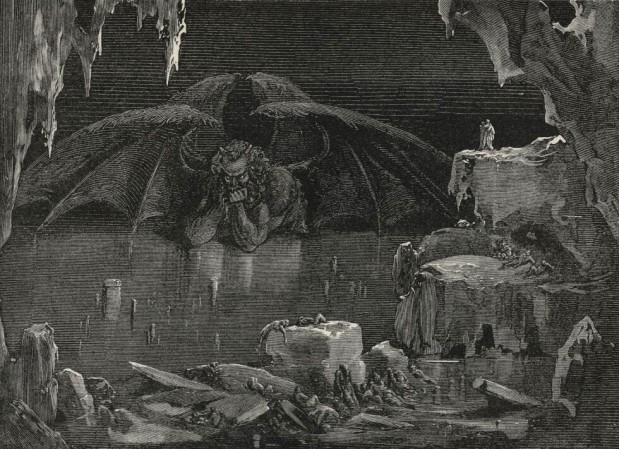
In my last two posts I’ve discussed four of the biggest beasts in Torrey. In my first post I discussed Frankenstein’s monster and Melville’s Moby Dick. In my last post I looked at Spencer’s great dragon and Dante’s Satan, all the while comparing the beasts to one another. Finally I have arrived at the final beast. This beast is so great that it has beasts beneath him that he empowers. It is Satan, the Dragon of Revelation.

Revelation’s Dragon

In Revelation, John writes down the images and visions that Jesus shows him. After seeing many different things, he sees another sign.

And another sign appeared in heaven: behold, a great red dragon, with seven heads and ten horns, and on his heads seven diadems.  His tail swept down a third of the stars of heaven and cast them to the earth. (Rev 12:3-4)
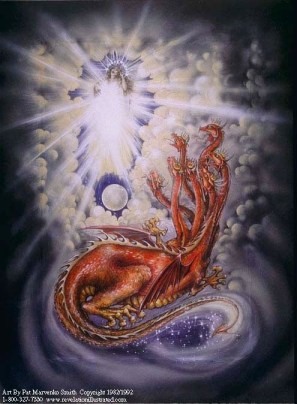
The_Woman_and_the_DragonThe great red dragon of revelation does not have long descriptors like those of the other monsters, but he is much greater. John sees him in heave and witnesses his magnitude. The dragon has seven heads (more than Dante’s three faces), ten horns, and seven diadems on each head. The diadems show that the beast is royally adorned and the horns denote power, more power than he has heads even. His tail is larger than Moby-Dick’s or Spencer’s dragon as it wipes out a third of the stars in the heavens and casts them down to earth (this may or may not be the angels, which still shows that he has power since he was able to deceive them to follow him).

The vision continues:

Now war arose in heaven, Michael and his angels fighting against the dragon. And the dragon and his angels fought back, but he was defeated and there was no longer any place for them in heaven. And the great dragon was thrown down, that ancient serpent, who is called the devil and Satan, the deceiver of the whole world— he was thrown down to the earth, and his angels were thrown down with him. (Rev 12:7-10)

The dragon was in heaven and fought the great angel Michael. The dragon, who is revealed to be the serpent Satan, looses and is cast down out of heaven to the earth. But even here he is shown with power. He is called ancient and the deceiver of the whole world. How powerful does he have to be to deceive the whole world? Even ancient is a display of strength as he is not some young force. Even being cast down out of heaven, he has strength. Continue reading

Battle of the Beasts (part 2)

Battle of the Beasts (part 2)

In my last post, I started a discussion about the beasts in Torrey. While there are political beasts (Hobbes’ Leviathan) and books that are beasts themselves (Russian novels), I wanted to focus on the five biggest beasts. In my last post I discussed Frankenstein’s monster and Moby-Dick. Both were impressive in size and had unique characteristics. The last three beasts though are even bigger and completely evil. They include two dragons and one huge being. They each stand for the highest evil in their works.

The Faerie Queen Dragon

At the end of Book I of Edmund Spenser’s Faerie Queen, the protagonist, Redcrosse encounters the great dragon the Faerie Queen had sent him to kill for Una, the woman of truth. The dragon had captured Una’s kingdom and forced her parents to hide in a high tower. As Una and Redcrosse approach her kingdom, the dragon appears.

Continue reading

Battle of the Beasts (part 1)

Battle of the Beasts (part 1)

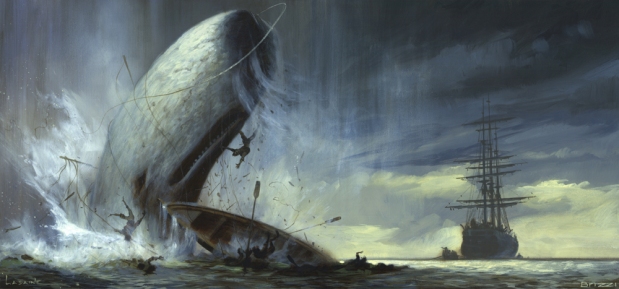
The Torrey Cannon is full of beasts of many different kinds. Some are political structures the size of a Leviathan (Hobbes), some books are beasts in themselves (any Russian novel), and some books have actual beasts in them. While I could look at hundreds of beasts in Torrey in Ovid, all throughout Dante, and in poetry, I want to focus on the five biggest beasts. Each of these beasts is unique, whether it be their origin, their place of living, their structure, how they are or aren’t defeated, and more. Since these beasts or monsters are huge, I want to divide this topic into three posts, this being the first in which I’ll be focusing on Frankenstein and Moby-Dick. These two monsters are the most different from the other three, and possibly smaller, so it is right to do these first. In my second post I will analyze three more monsters (though much quicker), compare them all, and look at what makes a monster.

Frankenstein

Victor Frankenstein once had a good family life, but became so engrossed in his studies that he essentially cut them off. He began studying the cause of life, but “to examine the causes of life, we must first have recourse to death” (52). He studied all supernatural horrors. Continue reading

To Infinity and Beyond: Dionysius on Being and Evil

Dionysius

It took most of my freshman year to understand Plato’s ideas of Being and Becoming. It was a shock to me when Pseudo Dionysius took it a step further. As soon as I started reading him I messaged an upper class man to try to understand what was going on. She helped me complete my understanding of Plato and helped me see further up into Dionysius’s thoughts.

In the opening pages of Pseudo Dionysius’s The Divine Names, he writes about God as beyond Being itself.

We must not dare to resort to words or conceptions concerning that hidden divinity which transcends being, apart from what the sacred scriptures have divinely revealed. Since the unknowing of what is beyond being is something above and beyond speech, mind, or being itself, one should ascribe to it an understanding beyond being. Continue reading

Plato like Play-Doh: Being and Becoming

Being and Becoming. What do these terms even mean for Plato? This was probably one of the most difficult ideas to wrap my mind around freshman year. I heard professors talking about it all the time, but I never could figure out what it meant. After thinking about it for a semester, I was finally able to figure it out.

Plato explains his system of existence in Timaeus. He breaks existence down into three categories: Being, becoming, and space. Continue reading

Aristotelian Virtue

What is virtue? How does one practice it? Does virtue measure actions or a person?

One of the primary authorities in Torrey on virtue is Aristotle who examines virtue in Nicomachean Ethics. Aristotle, a student of Plato, thought differently about virtues than Plato. Where Plato believed in forms of virtue, Aristotle believed in moderation.

Virtue

nicomachean-ethics_3821_400Aristotle describes  virtue as “a mean between two vices, one of excess and one of deficiency” (II.9). This is a sort of moderation or temperance, where one aims at the middle to achieve the goal. Aristotle applies to all virtues such as courage, generosity, and magnanimity. If courage is the median, then a deficiency of it is called cowardliness and an excess of it is rashness (Book III). For generosity, the deficiency is stinginess and the excess is wastefulness (Book IV). For magnanimity (essentially the virtue of knowing your place in society in relation to honor, or greatness of soul) the deficiency is smallness of soul while the excess is vanity.

Magnanimity is Continue reading

The Smudge of Sin: Athanasius and Anselm

God expresses his beauty through creation. There is no doubt of the beauty of the lilies that do not toil or spin. One can only stand in awe when looking up at the night sky full of stars and galaxies. The complexities of even the smallest cells, molecules, atoms, and everything smaller show the immense detail of creation while the world, stars, and galaxies show the vastness of his power. Yet in all of creation, nothing is so unique as man who bears the image of God. He is God’s masterpiece of creation.

Yet something has happened. Anselm of Canterbury writes, “The human race, clearly his most precious piece of workmanship, has been completely ruined” (A, 269).  Sin has contaminated the great masterpiece and ruined it.

Athanasius and Anselm both refer to sin as a smudge on the masterpiece of God.

athanasiusAthanasius focuses on the incarnation in his work so aptly named On the Incarnation. He delves into the purposes of the incarnation and why it was necessary. As he talks about man’s redemption, he compares it to an artist and an old portrait. Continue reading